0
฿0.00
An empty cart
You have no item in your shopping cart


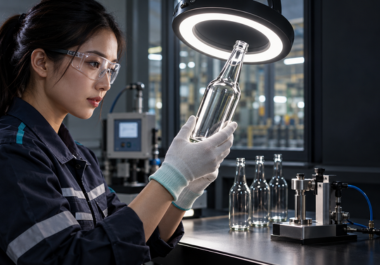
Glass bottle manufacturing combines extreme temperatures, high-speed machinery, and continuous production. Molten glass must be formed with precision, while pneumatic valves, actuators, and control systems must operate reliably around the clock.
Compressed air plays a particularly important role in blow-forming, where air helps shape molten glass inside a mould. However, supplying sufficient airflow and pressure is only part of the requirement. The air must also be properly dried and treated to prevent moisture from affecting equipment and production.
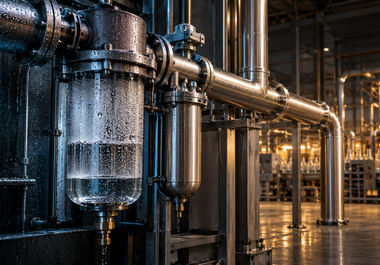
Atmospheric air naturally contains water vapour. When air is compressed, the concentration of moisture increases. As the compressed air subsequently cools, water vapour may condense into liquid inside pipes, valves, receivers, and production equipment.
This moisture can contribute to:
For a glass plant operating continuously, even a small disruption can affect production volume and create substantial waste. Air treatment should therefore be considered part of the manufacturing process, not merely a supporting utility.
Pressure dew point indicates the temperature at which moisture begins to condense at the operating pressure of the compressed-air system.
For example, if compressed air has a pressure dew point of 7°C, liquid water should not form as long as the air remains above that temperature at the specified pressure. If the air or piping temperature falls below the pressure dew point, condensation may appear.
The required pressure dew point depends on the production process, installation environment, lowest expected pipe temperature, and sensitivity of downstream equipment. A lower dew point is not automatically better if the process does not require it, because producing extremely dry air can increase energy and investment costs.
In glass-container manufacturing, hot compressed air may be required to help form molten glass inside moulds. The supplied air must be stable in temperature, pressure, flow, and moisture content.
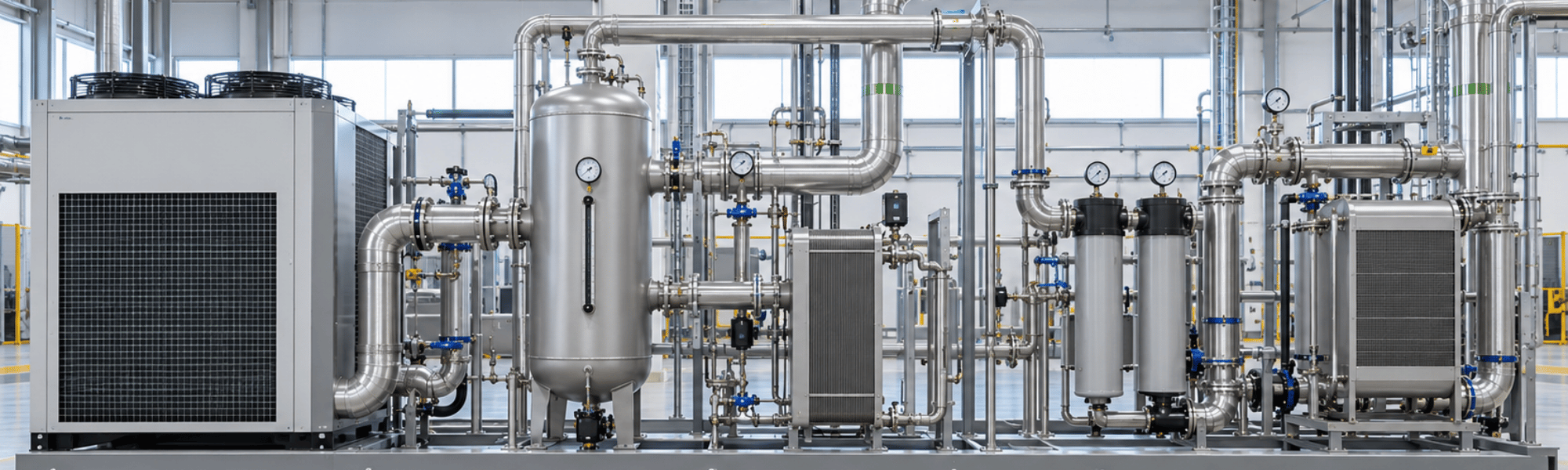
The referenced application used a multistage drying arrangement with air-to-air and air-to-water heat exchangers. The system first reduced the temperature and moisture content of the incoming air, separated condensed water, and then regulated the outlet temperature before the air entered the forming process.
This illustrates an important principle: the correct solution may involve more than installing a standard air dryer. Heat exchangers, cooling systems, moisture separation, filtration, reheating, and precise temperature control may need to work together.
Several dryer technologies can be considered for glass manufacturing.
Refrigerated dryers cool compressed air so that water vapour condenses and can be separated. They are commonly used for general plant air where a moderate pressure dew point is sufficient.
Desiccant dryers use adsorption material to produce much lower pressure dew points. They may be appropriate for sensitive instruments, cold environments, or critical processes requiring very dry air.
Heat-of-compression dryers can use heat generated during oil-free compression to regenerate the drying material. They may be considered for large, continuous-duty installations where the compressor and dryer can be designed as an integrated system.
The correct choice depends on flow, pressure, inlet temperature, required dew point, operating schedule, ambient conditions, energy consumption, and lifecycle cost.
An air dryer should not be selected independently from the rest of the compressed-air system. A complete arrangement may include:
Filters must be correctly positioned in relation to the dryer. Pressure drop across filters, dryers, valves, and piping should also be controlled because every unnecessary pressure loss can increase compressor energy consumption.
Dew-point sensors help operators confirm that the system is delivering air at the required dryness. Monitoring pressure, temperature, flow, and differential pressure can also reveal filter blockage, drain failure, excessive demand, air leakage, or declining dryer performance.
Preventive maintenance should include checking drains, cleaning heat exchangers, replacing filter elements, inspecting valves, verifying sensor calibration, and confirming that cooling and regeneration systems operate correctly.
Selecting an air dryer by nominal flow capacity alone can lead to poor moisture removal and unstable production. Dryer performance is influenced by inlet temperature, pressure, ambient conditions, peak airflow, cooling-water availability, and the pressure dew point required at the actual point of use.
Glass-forming applications may also require controlled outlet temperature—not simply dry air. The dryer, heat exchangers, filters, drains, controls, and distribution piping must therefore be engineered as one coordinated system.
Our engineering team can evaluate your compressed-air demand, inlet conditions, dew-point requirement, operating temperature, and production schedule. Contact us to develop an air-treatment system that protects pneumatic equipment, supports consistent bottle forming, and improves the reliability of your glass-manufacturing operation.

Efficient air systems save costs, ensure clean supply, and extend equipment life. Domnick (Thailand) can help design or upgrade yours.