฿3,140.00
Total: ฿3,140.00


Total: ฿3,140.00


Total: ฿3,140.00
In every pneumatic system, the quality of compressed air defines the reliability and lifespan of your equipment. Dust, oil, and moisture are the hidden enemies that gradually reduce efficiency, cause wear, and lead to unplanned downtime.
That’s why understanding air preparation — the process of filtering, regulating, and lubricating compressed air — is essential for maintaining high performance and long-term durability in any industrial setup.
From clamping and positioning to pushing and lifting, consistent air quality at the right pressure ensures that your pneumatic tools and actuators work exactly as designed. Without proper air treatment, even the most advanced pneumatic systems can underperform or fail prematurely.
Compressed air doesn’t travel in perfect condition. On its way from the compressor to the machine, it passes through pipes, valves, and fittings that can introduce particles, oil mist, and moisture into the air stream. These contaminants accumulate inside cylinders, valves, and seals — causing corrosion, friction, and eventually system failure.
Air preparation systems act as a protective barrier, conditioning the air before it enters your pneumatic equipment. This ensures:
Cleaner, drier air for improved reliability
Reduced wear on valves and actuators
Lower maintenance frequency and costs
Extended machine service life
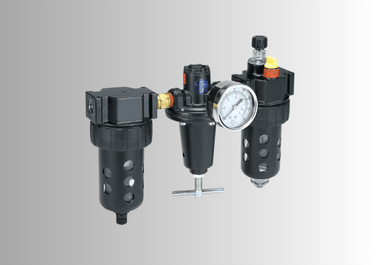
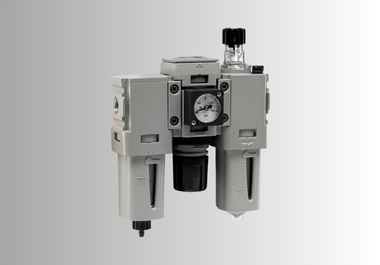
An air preparation setup typically includes three main components: Filters, Regulators, and Lubricators — commonly known as FRL units.
Compressed air filters are the first component in your air preparation system. Their main purpose is to remove solid particles, oil aerosols, and water from the compressed air before it reaches sensitive components.
Standard filters typically remove particles around 40 microns, while fine or coalescing filters can capture contaminants as small as 5 microns or less — ideal for precision applications such as instrumentation, food, and pharmaceutical processes.
For example, Parker’s 14F miniature particulate filter offers exceptional filtration in compact form, maintaining air purity in demanding systems.
Regular maintenance keeps your filters performing effectively. The filter bowl, where contaminants collect, must be drained periodically using:
A manual drain,
A semi-automatic drain, or ideally,
An automatic drain for continuous operation.
Additionally, filter elements should be checked and replaced when necessary. Coalescing filters often feature a Pressure Drop Indicator (PDI) to signal when the element is clogged or needs replacement — helping maintain efficiency and prevent pressure losses.
Once the air is filtered, the next step is to control its pressure.
A pressure regulator ensures that downstream pneumatic devices receive air at a consistent, safe, and optimal pressure — regardless of fluctuations in the main line.
Turning the regulator knob clockwise increases outlet pressure, while counterclockwise decreases it. This simple control mechanism allows operators to fine-tune air delivery for each application.
Best practice: regulators should only be used for pressure control. For on/off control or to start/stop air flow, a dedicated shut-off valve should be used instead.
To save space and simplify installation, many manufacturers now offer filter-regulator combinations (FR units). These compact assemblies provide the same functionality as separate components but occupy less space and reduce setup costs — ideal for modern, space-limited pneumatic panels.
While some pneumatic devices today are pre-lubricated and require little to no additional oil, many high-speed pneumatic tools and older systems still rely on lubrication for smooth, efficient performance.
A pneumatic lubricator adds a controlled mist of oil into the compressed air stream, forming a fine fog that travels downstream to lubricate moving parts like cylinders, valves, and rotary tools. This process reduces friction, minimizes wear, and helps keep seals flexible — extending the lifespan of your equipment.
Adjustable oil feed: to control the exact amount of oil delivered
Visual indicators: to monitor oil flow easily
Oil reservoirs in various sizes to match system demand
Maintaining the correct oil level ensures consistent lubrication and prevents air tool damage or performance loss.
A complete FRL system — combining filters, regulators, and lubricators — ensures that every cubic meter of compressed air reaching your equipment is clean, dry, properly pressurized, and lubricated.
Modern FRL systems can be configured as 3-piece modular units, designed for:
Accurate pressure control
High-efficiency moisture removal
Consistent oil delivery across varying air flows
These units are compact, easy to install, and ideal for both new setups and system upgrades. By using modular designs, you also save on panel space, installation time, and maintenance costs.
To keep your pneumatic system running efficiently for years:
Inspect filter bowls regularly — drain moisture and replace elements as needed.
Monitor regulators — ensure downstream pressure is stable and within specification.
Check lubricator oil levels — maintain proper oil feed rates to prevent over- or under-lubrication.
Schedule preventive maintenance — contamination builds up over time, even with clean air supply.
Proper design, correct specification, and regular maintenance will ensure your air preparation system delivers consistent performance and long-lasting protection for all pneumatic components.
At Domnick (Thailand), we understand that clean and controlled compressed air is the key to a reliable production line.
We provide consultation, design, and installation of air preparation and FRL systems, including Parker’s industry-leading components, to help you achieve optimal efficiency and uptime.
With more than 30 years of experience in compressed air and pneumatic systems, we deliver solutions that reduce energy use, extend component life, and keep your operations running smoothly — day after day.

Efficient air systems save costs, ensure clean supply, and extend equipment life. Domnick (Thailand) can help design or upgrade yours.