0
฿0.00
An empty cart
You have no item in your shopping cart


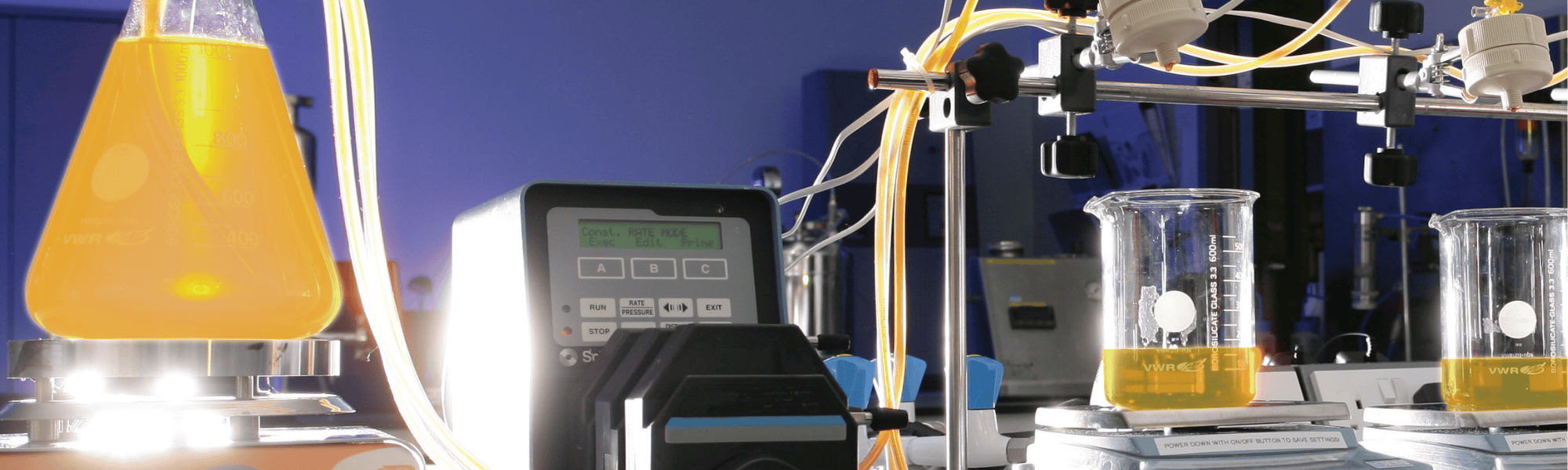
In the competitive world of biopharmaceutical manufacturing, scaling up from lab to production is one of the most critical—and challenging—steps. Many R&D teams develop successful lab-scale processes that later face roadblocks when transferred to full production. The result? Costly delays, additional development work, and a longer time-to-market.
The good news is that with the right technology and strategy, these issues can be minimized. Modern single-use bioprocessing systems and automated solutions now make it easier than ever to achieve smooth, efficient, and scalable production.
This article outlines three essential strategies—drawn from Parker’s technical insights—to help bioprocessing professionals scale up successfully, maintain consistency, and ensure long-term reliability.
Bioprocessing typically involves two major phases:
Upstream processing — cultivating and propagating cells that produce the target product.
Downstream processing — purifying that product through a series of steps like chromatography, tangential flow filtration (TFF), and sterile filtration.
Each stage poses unique scale-up challenges:
Filter sizing: Small-scale filters used in R&D may not handle the same pressure or volume at production scale, causing filter fouling and downtime.
Chromatography performance: Inadequate scaling can lead to reduced binding capacity or elution inconsistencies.
Pressure variations: Smaller lab equipment often withstands higher pressure than large-scale units—raising the risk of overpressure during scale-up.
To avoid these pitfalls, ensure that technology and materials used in the lab are scalable and pre-qualified for production use. This allows for:
Faster validation and material vendor qualification.
Consistent terminology and training across departments.
Greater confidence and shorter operator training time.
By anticipating these scale-up factors early, your team builds a foundation for faster, safer technology transfer and a smoother move to commercial production
One of the most common scale-up challenges occurs when the R&D process is developed using technologies or systems unfamiliar to the production team. When processes are handed over without alignment in equipment or software, it can create confusion, inefficiencies, and deviations.
To overcome this, adopt consistent technology platforms between small-scale development and production environments. The benefits include:
Seamless scalability: Control parameters defined at small scale can be replicated at pilot and commercial scales.
Operational continuity: Uniform user interfaces and automation software minimize training gaps.
Predictable results: Consistency reduces variability and strengthens process validation.
By designing your workflow with scalability in mind from the start—whether using modular single-use systems or digital automation—you can ensure that scale-up is a continuation, not a reinvention.
Human error remains one of the biggest risks in biopharmaceutical production. Using the Skill–Rule–Knowledge (SRK) framework, developed by Jens Rasmussen, helps identify where mistakes are likely to occur during industrial operations.
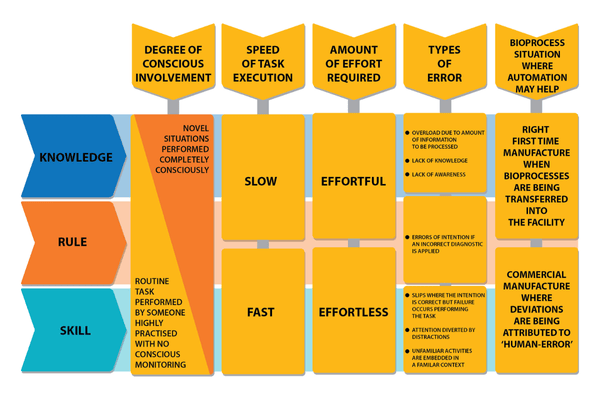
Common issues include:
Overloaded new operators who receive too much information while performing tasks.
Experienced operators missing changes because they perform repetitive tasks too quickly.
Attention lapses during routine processes, leading to incorrect manual entries.
The solution? Automation.
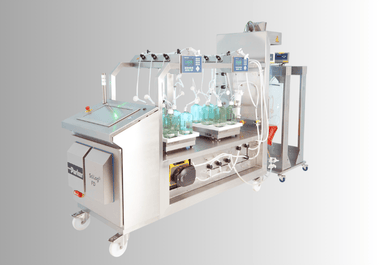
Automating key steps—such as normal flow filtration (NFF)—eliminates subjectivity and reduces transcription errors. Automated systems like Parker’s SciLog® FilterTec and NFF filtration units enable:
Real-time pressure control via integrated sensors.
Automated data recording and visualization.
Consistent, transcription-free reporting.
Configurable safety alarms to prevent overpressure or overfill.
With automation, R&D teams can run multiple filtration tests simultaneously, analyze data automatically, and easily scale from lab to GMP-level production without data loss or rework
In one case, Parker supported a client performing sterile filtration and bulk filling of a high-potency drug. The challenge was to maintain safety and process integrity during a 25-liter batch at a pressure limit of 2 barg (29 psig).
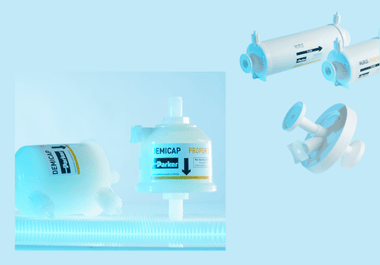
By performing small-scale tests using Parker’s PROPOR HC filters, the team validated flow rate, pressure, and capacity parameters—achieving a 40% safety margin for production. Pilot-scale confirmation ensured reliable scalability without filter blockage or process failure.
The use of automated filtration and analytical control improved precision, minimized operator variability, and ensured repeatable, compliant results from lab to production
Scaling up bioprocessing isn’t just about larger volumes—it’s about maintaining consistency, quality, and control at every stage. Success comes from designing with scalability in mind, applying robust process monitoring, and staying agile to manage risk.
At Domnick (Thailand), we help our partners scale with confidence by combining proven filtration technologies, process expertise, and local technical support—ensuring every production step delivers reliable performance and regulatory assurance.

Domnick (Thailand) is ready to assist you with your process filtration needs. Whether you’re designing a new system, upgrading your existing setup, or seeking to improve efficiency and purity across your operation, our filtration specialists are here to help you choose the right solution for your application.