฿611,000.00
Total: ฿611,000.00

Total: ฿611,000.00


Total: ฿611,000.00

Lens manufacturing requires exceptional control of particles, moisture, oil, temperature, and handling conditions. Even microscopic contamination can interfere with polishing, coating, inspection, assembly, and the final optical performance of a lens.
Compressed air can support many operations across an optical-production facility, including pneumatic machinery, component handling, instrument purging, non-contact particle removal, cleaning equipment, and cleanroom utilities. However, ordinary workshop air should never be assumed suitable for direct contact with precision optics.
Any air used near an optical surface must be engineered and validated for the application.
Precision lenses, mirrors, filters, and coated optical components are sensitive to contamination. Dust, water, oil, fingerprints, and cleaning residue can cause:
Particles on an optical surface can affect performance and, in high-power laser applications, may absorb energy and generate sufficient heat to damage the lens. asphericon
Prevention is therefore generally safer and more economical than repeatedly cleaning a contaminated optic.
Depending on the production process, compressed air may support:
Each application may require a different air-quality specification. Air used only inside a pneumatic actuator may not require the same treatment as air that directly contacts a finished lens.
Loose dust should generally be removed before any wiping process because larger particles trapped under a cleaning tissue may scratch the optical surface. Approved dry air or a suitable dust-free blower can remove loose particles without directly touching delicate coatings. Edmund Optics
However, air from an untreated factory compressor may contain moisture, oil aerosol, vapour, pipe scale, rust, or other particles. Directing contaminated air onto a lens can deposit a film or create additional defects instead of cleaning it.
For critical optics, facilities may use:
The correct method depends on the substrate, coating, contamination, cleanliness requirement, and approved manufacturing procedure.
Oil-free compressor technology can reduce the risk of lubricant entering the compression chamber and contaminating the air supply. This may be appropriate where air is used in cleanrooms or near sensitive optical processes.
However, “oil-free compressor” does not mean that the complete system is automatically contamination-free. The intake air, piping, receivers, filters, dryers, and previous system history can still influence air quality.
An oil-lubricated compressor may serve non-contact factory applications when supported by correctly designed treatment equipment, but it should not be used for direct optical contact unless the delivered air has been tested and approved for that purpose.
The decision should be based on risk, required purity, monitoring capability, and total lifecycle cost.
A complete compressed-air system for precision optical manufacturing may include:
ISO 8573-1 provides compressed-air purity classes for particles, water, and oil. The required class should be specified at the point of use and based on the actual process risk—not selected from a generic recommendation. Part 1: Contaminants and purity classes
Water in the air system can cause corrosion, interfere with pneumatic components, leave spots on optical surfaces, and support contamination inside the distribution network.
The dryer should be selected according to:
Producing air that is much drier than required can waste energy. The correct objective is to maintain the specified dew point reliably at the point where the air is used.
High-efficiency filters can remove particles and oil aerosols, but filters cannot correct every source of contamination. Old carbon-steel piping may release rust or scale downstream of the treatment system, while improperly maintained drains can allow water to re-enter the network.
For critical applications, point-of-use filtration should be installed as close as practical to the process. Piping materials, dead legs, flexible hoses, seals, and fittings should also be selected for cleanliness and compatibility.
System commissioning should include cleaning, purging, testing, and documented acceptance of air quality.
A clean-air system must continue meeting its specification throughout operation. Useful monitoring may include:
Maintenance should include filter replacement, dryer inspection, drain testing, receiver checks, sensor calibration, leak detection, and periodic air-quality verification at critical points of use.
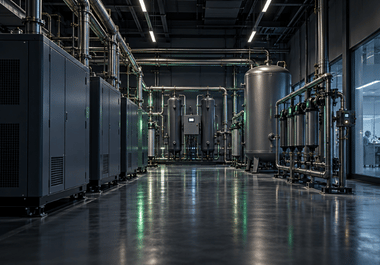
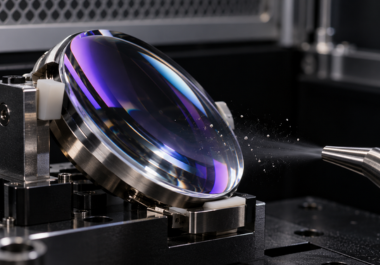
The most important question is not simply whether the compressor is oil-free. It is whether the air reaching the lens or production equipment meets the required particle, moisture, and oil specification under actual operating conditions.
Air can become contaminated after leaving the compressor through receivers, old piping, flexible hoses, saturated filters, or malfunctioning drains. For direct contact with precision optics, ordinary plant air should never be used without appropriate treatment, testing, and process approval.
Our engineering team can evaluate your pneumatic demand, point-of-use risks, cleanliness requirements, dew point, filtration, piping, and monitoring needs. Contact us to develop a compressed-air system that protects sensitive optical surfaces, supports precise manufacturing, and reduces contamination-related rejects.

Efficient air systems save costs, ensure clean supply, and extend equipment life. Domnick (Thailand) can help design or upgrade yours.