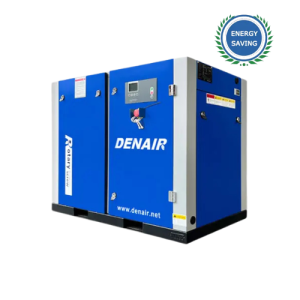
฿145,000.00
Total: ฿145,000.00

Total: ฿145,000.00


Total: ฿145,000.00
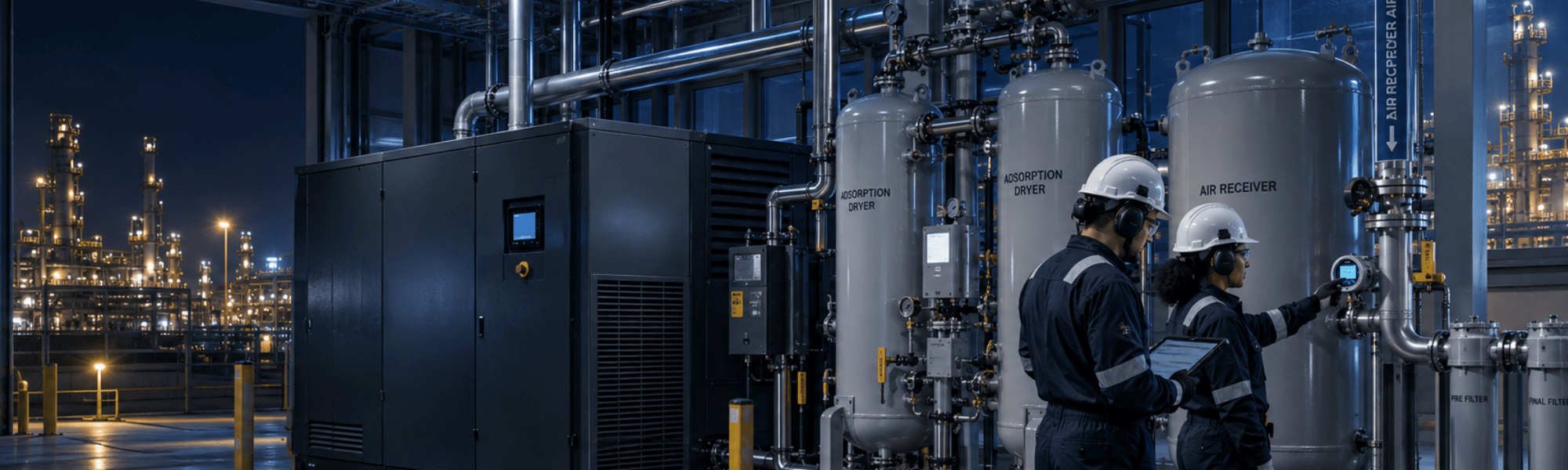
From exploration and drilling to processing, storage, and transportation, compressed air supports many essential oil and gas operations. It powers pneumatic equipment, operates control valves, supports maintenance activities, and supplies clean air for sensitive instruments.
Oil and gas facilities often operate continuously in dusty, corrosive, hot, cold, or hazardous environments. An air-compressor system must therefore deliver more than the required pressure and flow—it must provide dependable performance, suitable air quality, safe operation, and efficient energy use.
Compressed air may be used for:
Air used for instruments and process controls must be clean and dry. Water, oil, and particles can cause valves to stick, damage instruments, block small passages, and create unreliable readings.
Rotary screw compressors are widely used where a facility requires continuous or high-volume compressed air. They provide stable airflow and can serve central plant-air and instrument-air systems.
Oil-lubricated screw compressors may be suitable when the air is properly treated and the application permits them. Oil-free designs can reduce the risk of lubricant entering sensitive processes, although downstream drying and filtration are still required to control moisture and particles.
Variable-speed operation may improve efficiency when air demand changes significantly throughout the day.
Piston or reciprocating compressors are suitable for intermittent demand, smaller installations, and applications requiring higher discharge pressure. Their robust operating principle makes them useful for workshops, maintenance activities, starting air, testing, and specialised duties.
Because piston compressors produce pulsating airflow, the complete system may require a correctly sized receiver, vibration control, cooling, and condensate management. Maintenance requirements should also be evaluated carefully for continuous-duty applications.
Rotary-vane compressors provide smooth, consistent airflow and are often valued for their compact design and relatively simple operating mechanism. They can be suitable for continuous-duty applications with stable air demand and limited installation space.
The correct selection depends on capacity, pressure, air-quality requirements, ambient conditions, and the maintenance support available at the facility.
High-pressure compressors are designed for applications requiring pressure beyond a conventional plant-air system. Potential duties include pressure testing, specialised process support, cylinder filling, nitrogen boosting, and other engineered applications.
High-pressure air requires careful attention to material compatibility, cooling, filtration, pressure relief, piping design, and operating procedures. It should never be used for gas-service duties unless the compressor and complete system are specifically designed and approved for that gas.
The compressor is only one part of the installation. A reliable system may also include dryers, particulate and coalescing filters, air receivers, condensate separators, drains, pressure controls, monitoring equipment, and suitable distribution piping.
Engineers should assess average and peak airflow, minimum and maximum pressure, air-quality requirements, duty cycle, redundancy, hazardous-area classification, ambient temperature, installation altitude, cooling availability, and future expansion.
Choosing an air compressor by motor power or maximum pressure alone can result in unstable supply, excessive energy consumption, and frequent maintenance. The compressor technology must match the actual demand profile and operating environment.
Our engineering team can evaluate your airflow, pressure, air quality, redundancy, installation, and safety requirements. Contact us to develop a compressed-air system that supports reliable production, protects critical equipment, and reduces long-term operating costs across your oil and gas operation.

Save energy, lower costs, and ensure reliable clean air. Whether building new or upgrading, Domnick (Thailand) delivers expert compressed air system design tailored to your needs.