0
฿0.00
An empty cart
You have no item in your shopping cart


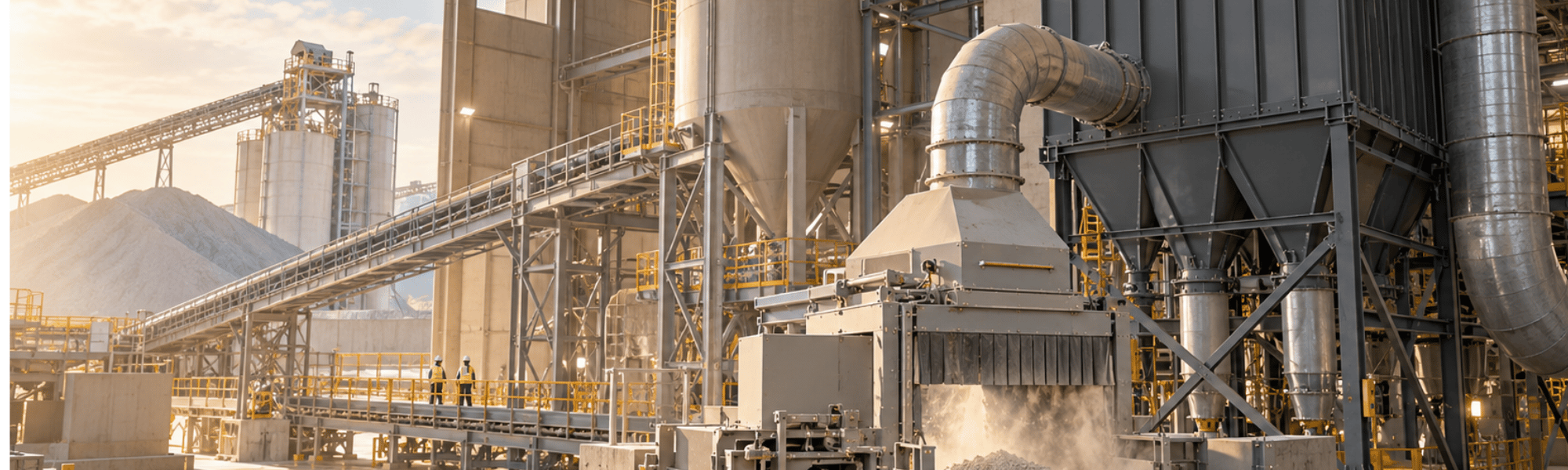
Dust is an unavoidable challenge across cement production, concrete processing, construction-material manufacturing, and heavy-equipment fabrication. Crushing, mixing, conveying, cutting, drilling, grinding, welding, and surface preparation can release fine particles and fumes into the workplace.
Without effective control, airborne dust can affect worker health, reduce visibility, contaminate machinery, increase cleaning requirements, and interrupt production. A properly engineered dust-collection system captures contaminants near their source and helps maintain cleaner, more reliable operations.
Common dust-generating processes include:
The characteristics of the dust vary significantly between processes. Cement powder, aggregate dust, respirable silica, welding fumes, metal particles, and blasting media cannot automatically be managed with the same filtration system.
Concrete, mortar, brick, block, stone, and sand can contain crystalline silica. Cutting, grinding, drilling, crushing, or sawing these materials may generate extremely small respirable particles that can penetrate deeply into the lungs. Long-term occupational exposure is associated with silicosis, lung cancer, chronic obstructive pulmonary disease, and kidney disease.
Visible dust is not a reliable indicator of exposure. A workplace may appear relatively clean while fine respirable particles remain suspended in the air. Dust assessment should therefore consider the material, process, exposure duration, particle size, and applicable local occupational-safety requirements.
Capturing dust as close as possible to the point where it is generated is generally the most effective approach. Source-capture solutions may include:
Research from NIOSH has shown that a grinder fitted with an appropriate local exhaust ventilation shroud can substantially reduce exposure during concrete grinding. CDC
Source capture may be difficult when employees work around large components, mobile construction equipment, or frequently changing production areas. In these situations, ambient filtration can help remove contaminants that escape primary capture.
Ambient systems should complement—not automatically replace—effective source control. Their performance depends on airflow patterns, ceiling height, process location, obstacles, make-up air, and the movement of cranes, vehicles, and employees.
Heavy-equipment manufacturing may involve welding, plasma cutting, grinding, machining, and abrasive blasting across large, open production bays. These processes can require a combination of local extraction, ambient filtration, containment, and specialised oil-mist control. RoboVent
Industrial dust collectors are available in cartridge, baghouse, cyclone, wet-collection, high-vacuum, and portable configurations. Selection should be based on:
Cement and mineral dust are not necessarily combustible, but mixed-process facilities may also generate combustible metal, coating, or organic dust. Dust testing and a formal risk assessment are essential before selecting explosion protection, spark control, isolation, or fire-suppression equipment.
A dust collector cannot perform effectively if filters are overloaded, ducts are blocked, extraction points are poorly positioned, or airflow is insufficient. Differential-pressure monitoring, automatic filter cleaning, scheduled inspections, and safe dust disposal help maintain system performance.
Good housekeeping remains important, but it should not redistribute settled dust into the air. Suitable industrial vacuum equipment is generally preferable to dry sweeping or uncontrolled compressed-air cleaning where hazardous fine dust may be present.
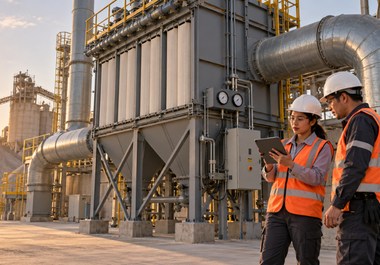
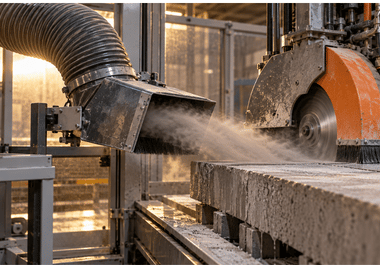
A larger fan or higher filter rating does not automatically create a better dust-collection system. Performance depends on capturing each contaminant with the correct hood design, airflow, duct velocity, filtration method, and discharge arrangement.
Designing the system without testing the dust or studying the actual workflow can lead to poor capture, excessive energy consumption, premature filter replacement, and avoidable safety risks. Cement processing, concrete cutting, welding, grinding, and abrasive blasting may each require a different control strategy.
Our engineering team can assess your dust-generating processes, plant layout, airflow requirements, filtration needs, and operating risks. Contact us to develop a dust-control solution that helps protect employees, improve workplace cleanliness, reduce equipment contamination, and support reliable cement or construction production.

Domnick (Thailand) is here to help. Whether you’re in the early stages of planning your clean air filtration system for a new facility or considering an upgrade or expansion of your existing setup, our team of Air Filtration and Collector System design experts is ready to assist you.