0
฿0.00
An empty cart
You have no item in your shopping cart


Modern metalworking facilities depend on speed, precision, and consistent edge quality. In laser cutting, the assist gas plays an essential role by removing molten material from the cutting path and controlling how the exposed metal reacts with the surrounding atmosphere.
Nitrogen is widely used when fabricators require clean, bright edges with minimal oxidation—particularly when cutting stainless steel, aluminium, and selected mild-steel applications. An on-site nitrogen generator allows manufacturers to produce gas at their facility instead of depending entirely on cylinders or bulk-liquid deliveries.
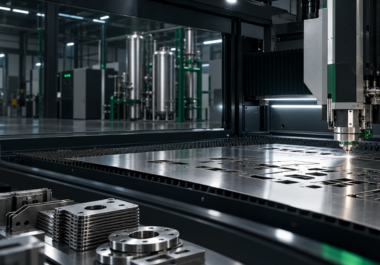
During laser cutting, the focused beam melts or vaporises material along a programmed path. High-pressure assist gas then clears molten metal from the cut or kerf.
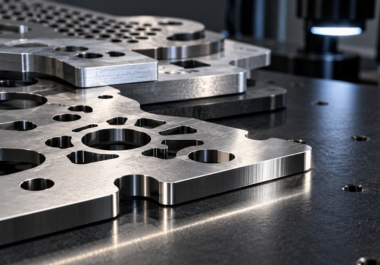
Unlike oxygen, nitrogen is an inert assist gas. It limits oxidation at the cutting zone and can produce:
The result depends on the material, thickness, laser power, nozzle, cutting speed, gas purity, pressure, and flow. Nitrogen does not automatically provide identical results across every application.
Nitrogen purity has a direct influence on oxidation and edge appearance. Laser-cutting applications may use purity levels ranging approximately from 99.9% to 99.999%, but the correct specification should be confirmed against the laser manufacturer’s cutting data and actual quality requirements.
Ultra-high purity is not always necessary. Some mild-steel and aluminium applications may achieve acceptable results at a lower purity, while stainless steel or demanding visible-edge applications may require higher purity.
Generating gas at a higher purity than the process requires can reduce generator output and increase energy consumption. The most economical specification is therefore the purity that consistently achieves the required cut—not simply the highest available value.
Gas cleanliness is also important. Oil, moisture, and particles can affect the cutting head, lens, nozzle, piping, and finished surface. Appropriate compressed-air drying and filtration must be included upstream of the nitrogen generator.
Nitrogen must reach the laser at sufficient pressure to eject molten material effectively. The required pressure varies significantly according to material and thickness.
Some laser-cutting processes may operate between approximately 10 and 30 bar or higher. Thin sheet may require lower pressure, while thicker material and larger nozzles can require substantially higher pressure and flow.
The system must account for losses through:
Pressure at the generator or booster outlet may therefore need to be higher than the required pressure at the laser inlet.
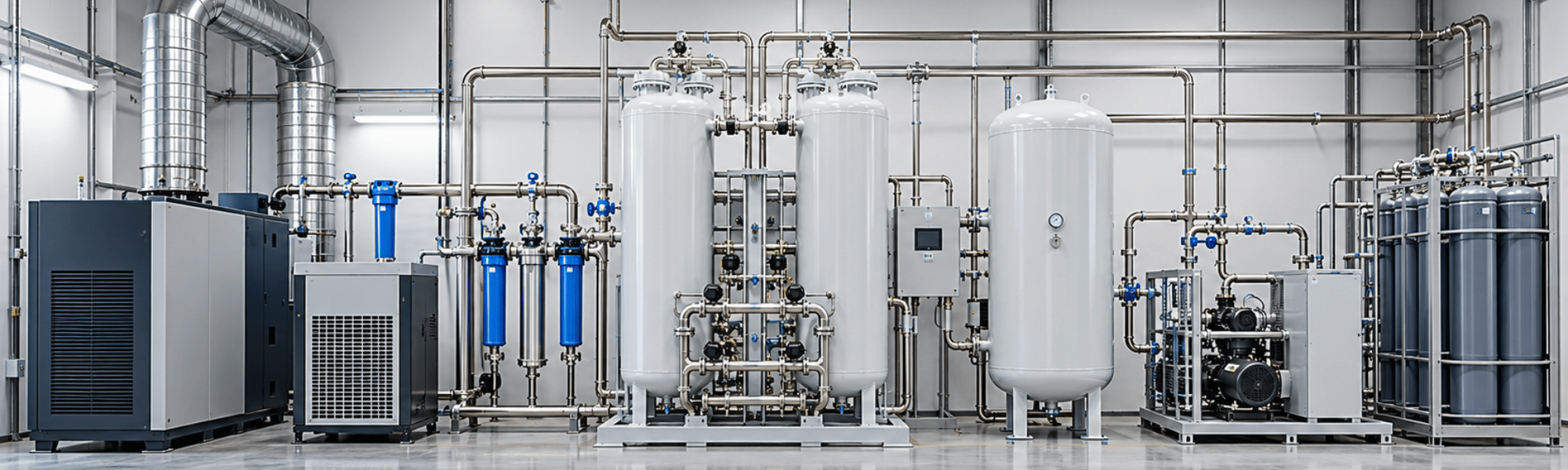
A complete system generally starts with an air compressor. The compressed air is dried and filtered before entering the nitrogen generator, where nitrogen is separated from the other components of atmospheric air.
Depending on the required delivery pressure, the generated nitrogen may then pass through a booster compressor before entering high-pressure storage vessels. The stored gas provides a buffer for piercing, machine acceleration, or other short periods of high demand.
A complete installation may include:
Each component must be sized as part of one coordinated system.
Compared with relying exclusively on delivered gas, on-site generation can provide:
However, the commercial benefit depends on gas consumption, electricity cost, operating hours, maintenance, existing supply contracts, and required system capacity. A lifecycle-cost assessment should be completed before investment.
The generator should not be sized using average gas consumption alone. Engineers should assess the most demanding production conditions, including:
Storage can help support short demand peaks, but it cannot compensate for a generator that is consistently undersized. Oversizing can also increase capital cost and cause inefficient operation.
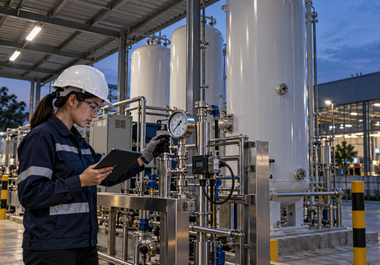
Continuous purity monitoring helps prevent off-specification gas from reaching the cutting machine. Pressure and flow monitoring can identify insufficient capacity, restrictions, leakage, or abnormal consumption.
Routine maintenance should cover the compressor, filters, dryer, separation equipment, analyser, booster, valves, and storage system. Filter elements, drains, sensors, and safety devices should be inspected according to operating conditions and applicable requirements.
Successful on-site nitrogen generation begins with the cutting process—not with the generator catalogue. Purity, pressure, and flow must be calculated from the materials, thicknesses, nozzles, laser settings, production schedule, and required edge finish.
Specifying unnecessarily high purity can increase energy consumption, while insufficient pressure or storage may cause poor melt removal during peak demand. The air compressor, dryer, filters, generator, booster, storage, piping, and controls must therefore be engineered as one complete gas-supply system.
Our engineering team can review your laser-cutting data, nitrogen consumption, gas quality, pressure profile, operating hours, and future capacity requirements. Contact us to develop an on-site N₂ solution that supports cleaner cuts, dependable production, and better control of long-term gas costs.
Domnick (Thailand) is here to help. If you are in the early stages of planning your gas generator system needs for a new facility, or if you are planning to upgrade or add to an existing system, we recommend that you speak with one of our Gas Generator System design experts.