฿1,130.00
Total: ฿1,130.00
![Transair® Quick Assembly Bracket With Female Thread ØD 25, 40, 50, 63 [WS]](http://www.domnickthailand.com/wp-content/uploads/2025/09/Quick-Assembly-Mini-Bracket-With-Female-Thread-1-300x300.jpg)
Total: ฿1,130.00


Total: ฿1,130.00

LG Chem’s NanoH₂O™ RO membranes for seawater and brackish water applications are engineered using advanced Thin Film Nanocomposite (TFN) technology.
Our seawater RO membranes offer industry-leading salt rejection of up to 99.89%, ensuring superior desalination performance.
LG Water Solutions’ proprietary TFN technology enhances membrane efficiency by embedding nanoparticles onto the membrane surface. This cutting-edge innovation significantly improves water permeability (flux) without compromising salt rejection, resulting in highly effective and dependable reverse osmosis performance. Compared to conventional Thin-Film Composite (TFC) membranes, our TFN membranes deliver superior salt rejection, as illustrated below:
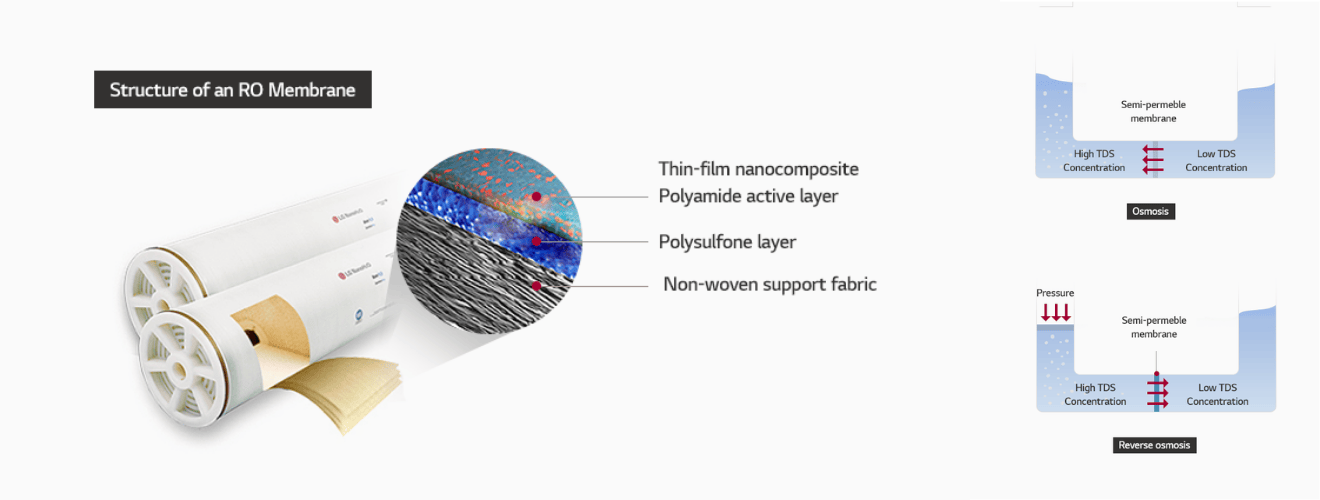
Osmosis is a natural process where water moves from an area with low total dissolved solids (TDS) through a semi-permeable membrane to an area with higher TDS. This movement occurs to equalize the concentration of solutes on both sides of the membrane.
Reverse osmosis is a water purification process in which pressure greater than the natural osmotic pressure is applied to the side with higher TDS. This forces water to move through the semi-permeable membrane toward the side with lower TDS, effectively reversing the natural direction of osmosis.